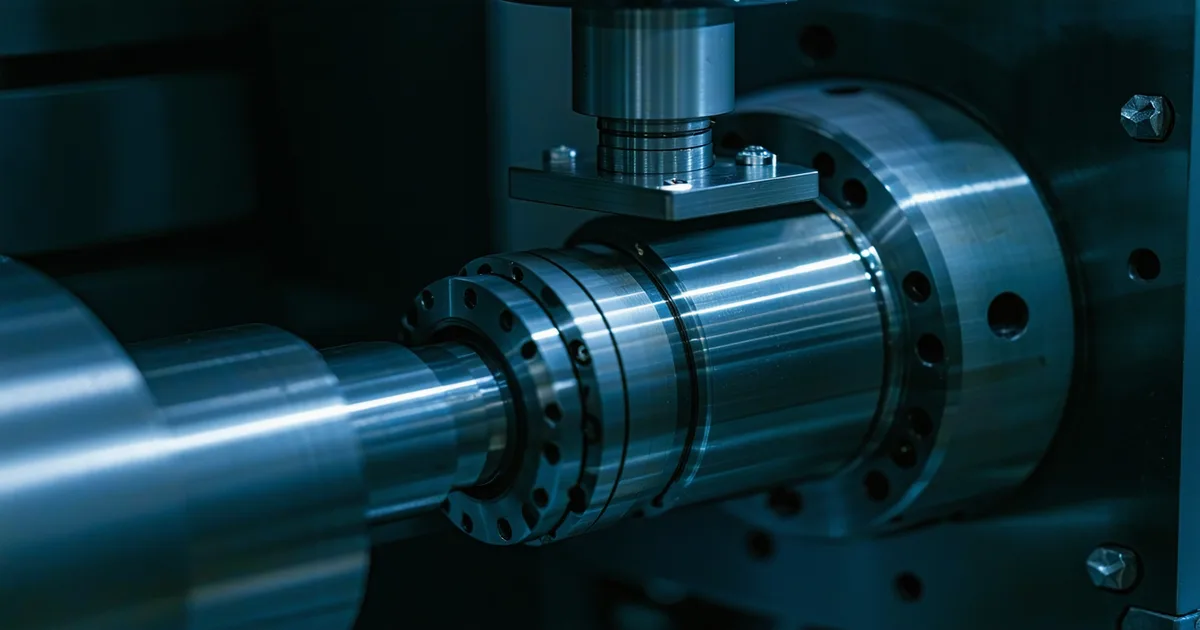
A modern CNC machining center generates a continuous stream of accelerometer data from its spindle. Depending on the sampling configuration, you might be capturing 5,000–25,600 samples per second per axis. That raw waveform contains every mechanical event happening inside the spindle housing — and if you know what you're looking for in the frequency domain, bearing defects announce themselves days or weeks before they cause a failure.
This article covers what bearing defect frequencies actually mean, how to read them in an FFT plot, and why envelope analysis is usually more useful than raw spectral magnitude for spindle condition monitoring in a CNC context.
The Four Bearing Defect Frequencies
Rolling element bearings have four characteristic defect frequencies derived from their physical geometry. You calculate them from the bearing's dimensional data — number of rolling elements, ball diameter, pitch circle diameter, and contact angle — combined with the shaft rotation speed.
BPFO (Ball Pass Frequency, Outer Race) is the rate at which rolling elements strike a defect on the outer race. Because the outer race is stationary, BPFO is typically the most prominent defect frequency in a fixed bearing. For a typical CNC spindle bearing with 12–16 rolling elements running at 3,600 RPM, BPFO commonly falls between 4× and 6× shaft frequency. An outer race defect with a localized spall will produce an impulse every time a ball contacts the damaged surface — in the time domain, you see periodic shocks. In the frequency domain, you see a peak at BPFO with harmonics at 2× and 3× BPFO.
BPFI (Ball Pass Frequency, Inner Race) is the rate at which a fixed point on the inner race (which rotates with the shaft) passes each rolling element. Because the inner race load distribution changes with shaft rotation, BPFI-related peaks are often modulated by shaft frequency — you'll see sidebands spaced at 1× shaft speed flanking the main BPFI peak. This modulation is a useful diagnostic indicator that separates inner race damage from other noise sources.
BSF (Ball Spin Frequency) characterizes defects on the rolling element surface itself. BSF is often difficult to identify cleanly because balls rotate on their own axis as they travel around the bearing — the frequency is load-dependent and can shift. In practice, BSF is rarely the primary diagnostic target for CNC spindle monitoring unless you see anomalous broadband noise with no clear BPFO or BPFI pattern.
FTF (Fundamental Train Frequency) represents the rotation rate of the cage. A cage defect produces a very low-frequency signal — typically less than half of shaft speed — that can be masked by low-frequency vibration from other sources. In high-speed spindles with ceramic hybrid bearings, cage defects do occur but are less common than outer or inner race damage.
Why Raw FFT Is Often Not Enough
A standard FFT of raw accelerometer data from a healthy spindle shows a response dominated by synchronous components — 1× shaft frequency (unbalance), 2× (misalignment), and harmonics. Early bearing defects generate relatively low-amplitude impulses that sit below this synchronous noise floor in the raw spectrum. You often can't see a BPFO peak directly in the FFT until the defect has progressed well into Stage 2 or Stage 3 on the ISO 13373 severity scale.
Envelope analysis addresses this. The technique demodulates the high-frequency structural resonance excited by bearing impacts rather than looking at the bearing defect frequency directly. The processing chain is:
- Bandpass filter the raw signal in the resonance frequency range (typically 1–20 kHz for steel spindle housings, though this must be identified for each machine class)
- Rectify the filtered signal (take the absolute value)
- Low-pass filter to extract the envelope
- Compute the FFT of the envelope — this is the Envelope Spectrum (ES)
In the envelope spectrum, BPFO and BPFI appear as clean peaks even when the defect is small, because the technique exploits the high signal-to-noise ratio at structural resonance rather than trying to find low-amplitude defect energy in a noisy broadband spectrum.
A Practical Example: 18-Machine CNC Turning Cell in Ohio
Consider a mid-size Tier-2 automotive components supplier running 18 CNC turning centers in a cell producing differential carrier blanks. The machines run two shifts at 4,200 RPM average spindle speed. Accelerometer nodes mounted on the spindle housing front bearing collect data at 12.8 kHz sampling rate. Each node streams data via OPC-UA DA to a local edge aggregator, then up to the condition monitoring platform.
On one machine, the envelope spectrum at 6-week intervals shows a BPFO peak growing from a barely-measurable 0.08 g to 0.31 g over three readings. BPFO harmonics at 2× and 3× also appear and grow in proportion. The raw vibration RMS measured at broadband (10 Hz–10 kHz) shows only minor elevation — from 0.9 g to 1.1 g — and would not have triggered a threshold alert under a standard RMS-only monitoring approach. The envelope analysis caught a progressive outer race spall while the machine was still running well within spec.
With 10 days of lead time, the maintenance team sourced a replacement spindle bearing through standard procurement (no expedite fee), scheduled the swap during a weekend maintenance window, and returned the machine to service in a 4-hour planned outage rather than a 12–18 hour emergency breakdown scenario.
Vibration Metrics That Actually Matter for CNC Spindles
Three metrics provide overlapping coverage for spindle health monitoring:
Vibration RMS (root mean square, broadband) measures overall energy in the signal. It's a good general health indicator but has poor sensitivity to early-stage bearing defects, which add minimal energy to the broadband signal.
Crest Factor (peak / RMS ratio) increases as bearing impulses become more impulsive relative to the background noise. A crest factor trending above 4–6 on a healthy machine is often the first broadband indicator of impact-type damage. However, crest factor tends to decrease again in late-stage bearing failure as the overall RMS rises sharply — it peaks in mid-progression and should be used in conjunction with other metrics, not alone.
BPFO/BPFI amplitude in the envelope spectrum is the most specific metric. Unlike RMS or crest factor, it correlates directly with a specific fault location and doesn't require the analyst to interpret a noisy wideband signal.
What Shaft Speed Does to Your Frequency Targets
CNC machining centers run across a wide RPM range — many spindles sweep from under 500 RPM for facing cuts to 10,000+ RPM for high-speed milling. Your bearing defect frequencies scale linearly with shaft speed. BPFO at 4,200 RPM might be 294 Hz; at 8,400 RPM it moves to 588 Hz.
This creates a practical problem for threshold-based monitoring: a fixed-frequency alert threshold set at 294 Hz catches the defect at one speed but misses it completely when the machine is running at a different RPM. Tracking analysis — where the monitoring system continuously adjusts target frequencies relative to measured shaft speed — is the right approach for variable-speed CNC spindles. This requires either a tachometer input or a reliable RPM estimate from the spindle drive's encoder feedback via OPC-UA.
We should be clear: this article covers the diagnostic signatures, not the mechanical root cause analysis that should follow a confirmed defect. Identifying a BPFO anomaly tells you the outer race has surface damage; it doesn't tell you whether that damage was caused by contaminated lubrication, overloading, improper installation, or end-of-life fatigue. The bearing defect frequency is the alert mechanism — the investigation is what happens after.
When Frequency Analysis Gives You False Comfort
There are failure modes on CNC spindles that do not produce clean bearing defect signatures. Spindle thermal distortion from inadequate coolant, contamination of grease through a worn seal, and fretting corrosion at the bearing seat all affect machine performance and long-term bearing life without necessarily generating strong frequency-domain indicators until they're quite advanced.
Combining vibration frequency analysis with temperature monitoring from the spindle housing and tracking spindle motor current for anomalous draw provides more complete coverage. A bearing running dry will typically show elevated housing temperature well before the vibration signature becomes diagnostic. These correlations are where multi-parameter monitoring adds genuine value over single-sensor approaches.
The fundamental point stands: if your plant is running CNC spindles with accelerometers already installed and you're not doing envelope analysis with BPFO/BPFI frequency tracking, you're reading a fraction of the data those sensors can provide. The signal is there. Whether you're listening is a software decision, not a hardware one.