
Most reliability engineers who end up in vibration analysis didn't set out to become signal processing specialists. They came up through maintenance, noticed that the machines with the worst failure records all had something in common, and started paying attention to what the sensors were actually saying. If that describes you, this guide is written for you — not for the PhDs, but for the engineers who need to use spectral data to make maintenance decisions on a plant floor.
What Vibration Data Is Actually Measuring
A vibration sensor on a rotating machine is measuring displacement, velocity, or acceleration — depending on the sensor type — as a function of time. That time-domain signal contains everything: the fundamental rotation frequency, harmonics, bearing defect frequencies, resonance responses, and noise. Raw time-domain data is hard to read directly, which is why virtually all vibration analysis work happens in the frequency domain after applying a Fast Fourier Transform (FFT).
The FFT converts that time signal into a spectrum: a plot of amplitude versus frequency. Each peak in the spectrum corresponds to a repeating mechanical event. The art of vibration analysis is learning which peaks belong to normal machine operation and which peaks represent developing faults.
A few numbers to orient yourself. Most industrial rotating equipment operates between 600 and 3,600 RPM — that's 10 to 60 Hz as the fundamental 1X rotation frequency. Bearing defect frequencies typically fall between 1X and 10X, depending on the bearing geometry. Gearmesh frequencies can reach several hundred Hz for high-speed, high-tooth-count gearboxes. If your analyzer samples at less than twice the highest frequency of interest (the Nyquist criterion), you'll miss the signatures you're trying to catch. For bearing analysis, 10 kHz sampling is a practical floor.
The Four Frequency Signatures That Matter Most
In discrete manufacturing — motors, gearboxes, pump assemblies, fans — four fault patterns account for the majority of rotating equipment failures. Understanding their spectral signatures gets you most of the way to useful vibration analysis without a signal processing background.
Imbalance shows up as a dominant peak at 1X (the fundamental rotation frequency). The amplitude scales with the amount of imbalance and the square of the running speed. A clean, well-balanced rotor has a 1X peak, but it's relatively low. When imbalance develops — from material buildup, a missing balance weight, or an asymmetric repair — the 1X amplitude climbs. You'll also typically see elevated vibration in the radial direction (perpendicular to the shaft axis). Imbalance that's been present for a long time shows up in accelerated bearing wear, which is why catching it early matters.
Misalignment produces a strong 2X component (twice the rotation frequency) in addition to the 1X. Angular misalignment drives axial vibration; parallel misalignment drives radial 2X. When both 1X and 2X are elevated and the axial reading is high relative to radial, misalignment is the first suspect. Laser alignment tools solve this in under an hour once identified.
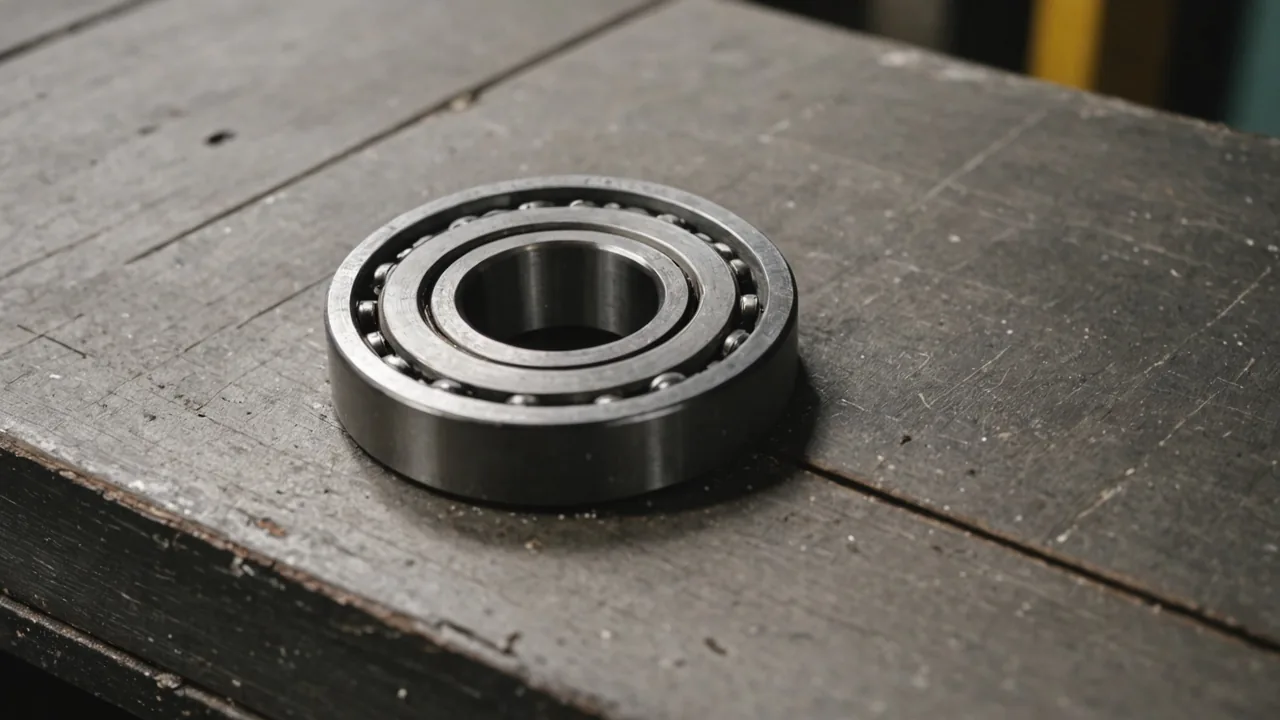
Bearing defects are detected through bearing defect frequencies: BPFO (ball pass frequency, outer race), BPFI (ball pass frequency, inner race), BSF (ball spin frequency), and FTF (fundamental train frequency). Each is calculated from the bearing geometry — inner and outer race diameters, ball diameter, and contact angle. The formulas are in every bearing manufacturer's catalog, and most vibration analyzers compute them automatically if you enter the bearing catalog number. A developing outer-race defect produces a spectral peak at BPFO and its harmonics; inner-race defects produce BPFI sidebands modulated at 1X. In the early stages, the best indicator is often the overall high-frequency energy (HFE) or envelope analysis rather than a clean spectral peak.
Gearmesh faults appear at the gearmesh frequency (GMF = shaft RPM × number of teeth) and its harmonics. A healthy gear produces a clean GMF peak with minimal sidebands. As tooth wear, pitting, or cracking develops, you'll see increased sideband energy around GMF separated by the shaft rotation frequency. Hunting tooth frequency — a sub-harmonic beat frequency related to tooth count combinations — can indicate a recurring contact pattern between specific teeth. When the sideband-to-GMF amplitude ratio climbs above 0.3, schedule the gearbox for inspection.
Sensor Placement: Where You Put the Sensor Determines What You Can Detect
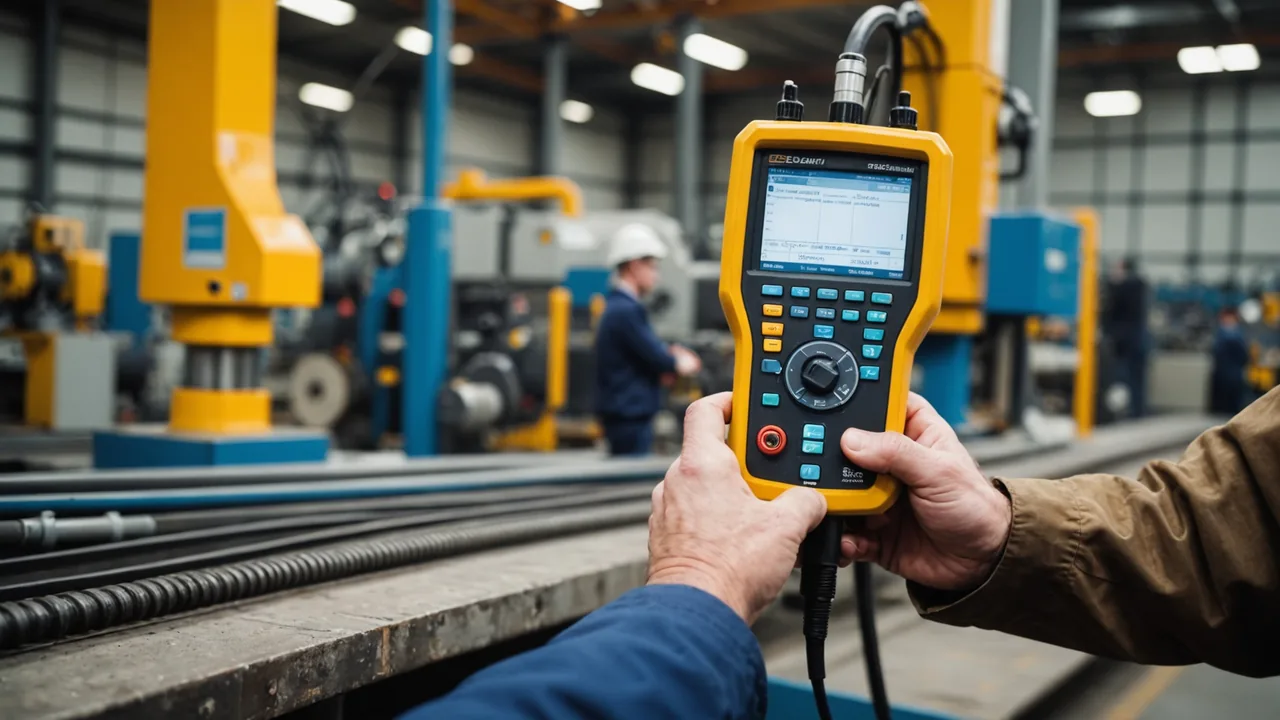
The best analyzer in the world won't help if the sensor is in the wrong location. For rolling-element bearings, the measurement point should be as close to the load zone as physically possible, with the measurement axis aligned with the primary load direction. On a horizontal motor, that means the housing closest to the bearing in the radial direction — typically top or side of the end bells. Measuring on top of the motor frame or on a mounting bolt is better than nothing, but you're adding structural attenuation between the fault source and the sensor.
For gearboxes, mount sensors on the bearing housings at each shaft location. The input shaft and output shaft bearings have different defect frequencies; measuring at one location gives you one shaft's bearing health. If the gearbox is a critical asset, instrument both shafts.
Triaxial sensors — measuring radial, axial, and tangential simultaneously — give you more diagnostic information from a single measurement point. They're worth the additional cost on high-value assets where distinguishing misalignment from imbalance matters. For routine screening across a large fleet, single-axis accelerometers in the radial direction provide enough information to flag anomalies that need further investigation.
Magnetic mounting is acceptable for route-based measurement but adds mass-loading variability to your readings. For continuous monitoring, adhesive or stud-mounted sensors provide consistent coupling and more reliable high-frequency response. If you're doing a one-time survey versus permanent installation, this matters more than people realize: different mounting methods on the same machine on different days will produce different amplitude readings at the same frequency, which can make trending unreliable.
Trending vs. Absolute Thresholds
There are published ISO standards for vibration severity — ISO 10816 / ISO 20816 series — that define acceptable overall vibration velocity levels by machine class and mounting type. These are useful baseline references. A machine running at 4.5 mm/s RMS velocity in the 10–1000 Hz band when the category limit is 2.8 mm/s is worth investigating. But absolute thresholds have a weakness: they don't account for the machine's own baseline. A gearbox that runs at 3.5 mm/s new and has been at 3.5 mm/s for two years is a healthy machine. A machine that has climbed from 1.8 mm/s to 3.5 mm/s over six months is a machine with an active degradation trend.
Trending is more informative than snapshots. Establish a baseline on each asset within the first two weeks of monitoring, then track amplitude at key frequencies over time. A 3 dB increase in overall vibration or a specific fault frequency band over 30 days is a more actionable trigger than crossing an absolute threshold for the first time — especially for machines that were already running above standard limits when you started monitoring.
We built Gearcadence's anomaly detection on this principle. The model learns each asset's normal operating envelope over a 2-week calibration window, then flags deviations relative to that baseline — not relative to a generic published threshold. The result is fewer false alarms on machines that legitimately run higher vibration due to load or installation geometry, and earlier detection on machines that are degrading from their own healthy baseline. In testing across bearing-type assets, this approach achieves TTF window accuracy within ±18%, because the model is tracking the degradation trajectory rather than a static threshold crossing.
What to Do When You Find a Fault
Spectral analysis tells you what's developing, not when to act. That decision requires translating the spectral evidence into a time-to-failure estimate and matching it against your production schedule.
Some general decision rules based on fault severity:
- Amplitude 2–3x baseline at a fault frequency: Schedule inspection at next planned maintenance window. Continue monitoring at increased frequency (weekly instead of monthly).
- Amplitude 5–8x baseline, or HFE in the kurtosis range >6: Schedule corrective maintenance within 2–4 weeks. Order parts now. Do not defer past the next planned shutdown.
- Amplitude >10x baseline or impulsive time-domain signal visible to the naked eye: Assess for immediate shutdown. The bearing or gear is in advanced degradation. Failure could be days or hours away depending on load.
These are rough guidelines. The asset's criticality matters: a motor feeding a redundant line with an identical spare in stock can run longer into degradation than the only drive on a single-path transfer line. Always factor in consequence severity and parts lead time when setting action thresholds.
One practical note from working with maintenance teams across US manufacturing facilities: the most common breakdown in vibration-based programs isn't poor detection — it's poor follow-through. The alert fires, the work order gets created, and then the repair gets deferred because no parts are in stock and the machine is still running. Six weeks later it trips in production. Keep storeroom inventory for your highest-probability fault modes on your most critical assets, and pre-stage the parts alongside the work order. That last step is what separates a functioning PdM program from an expensive data collection exercise.
Vibration analysis doesn't require a signal processing background to be useful. It requires understanding what four or five key spectral patterns look like, where to put the sensors, and how to trend the data over time. Start with your three or four highest-consequence rotating assets, get baselines established, and build from there. The investment in understanding pays back on the first avoided failure.